
Leaving them in a hot car. Leaving them in the bag after the whole thing gets rained on. Not inspecting after a fat shot and continuing to play with the club. These are some of the things that can damage your golf clubs and shafts.
These and more are some of the ways that countless golf shafts (and clubs) around the country are damaged year in and year out. Worst, damage incurred by these and other factors is, by and large, entirely preventable.
Taking care of your golf clubs will make them last a lot longer. Here’s what you should know.
Graphite golf shafts are more susceptible to damage from extreme temperatures than steel shafts, as the epoxy that binds the fibers can break down after repeated exposure to extreme heat, or to constant, wide temperature swings.
This means that, among other things, it is inadvisable to store your golf clubs in the cab of your car or even in the trunk, especially in the summer. Storing them in a garage or shed is acceptable if the space is climate controlled, or if it won’t experience extreme temperature swings.
Steel golf shafts, and steel heads, like irons and wedges, will rust if you let them remain wet for long, or equally if you subject them to conditions that are consistently humid.
This makes it imperative that you dry them off after you play in the rain. Use your rain fly, by all means, but when you get home, make sure you take your clubs and other equipment out of your golf bag and place everything in a cool, dry place with plenty of ventilation so that it all dries off.
If you do use club head covers, make sure that you remove them if the clubs have gotten wet, because while club covers can protect the clubs on the course or in transit, if they’re wet, they’ll just trap moisture next to the club head.
Also, while graphite golf shafts are not quite as susceptible to moisture damage as steel shafts are, golf grips can still rot or develop mold or mildew if they are allowed to remain damp for an extended period of time.
The solution is simple; make sure you’re fastidious about keeping your golf equipment dry.
If you ever clean your golf clubs or shaft, warm water and a mild detergent like dish soap should be all you’ll ever need, if you even need it at all. In most cases, warm water alone should do the trick.
Never use abrasive cleaners or any sort of solvent on any golf shafts or clubs, graphite or steel. These will scratch the finish, can encourage rust on steel, and in the case of graphite, can weaken the epoxy that binds the fibers, resulting in premature deterioration.
Also, don’t ever lean on your golf clubs like they’re canes, regardless of whether the shaft is steel or graphite (although this bad habit is worse for graphite). Doing so will stress the epoxy and fibers, and can cause the feedback of the shaft to become sluggish.
Worse yet, consistent pressure on graphite golf shafts can cause delamination that can result in a cracked or broken shaft, so for obvious reasons you’ll want to avoid that.
To that end, only use your clubs as clubs; never use them to tap dirt off your shoes, or allow them to contact hard surfaces like concrete or asphalt. Also, be gentle when removing your clubs from your golf bag; draw them out vertically, and gently, applying no lateral pressure to the shaft.
There are other things you can do to extend the life of your clubs and shafts. For instance, getting a golf bag that has full-length shaft dividers will help provide a higher level of protection to your golf shafts, whether in the trunk, in the cart, or just being carried on the course.
Full-length dividers cushion each golf shaft individually and help prevent them from rattling into each other, which all things considered can be worse for graphite shafts than steel shafts. Still, it is something that should be avoided if possible and many golf bags offer this feature, making it highly accessible.
Golf club head covers are a slightly contentious topic, but all the same, they can provide a very high degree of protection to your clubs by preventing them from rattling into each other. This protects the finish of the club head as well as any precision milled grooves or other features in the club face.
Those who are against them say they trap moisture which can encourage rust or other damage, but the solution is simple. Just slip the golf club head covers on before you go to the range or course. You can always take them off when you get home so your clubs can breathe.
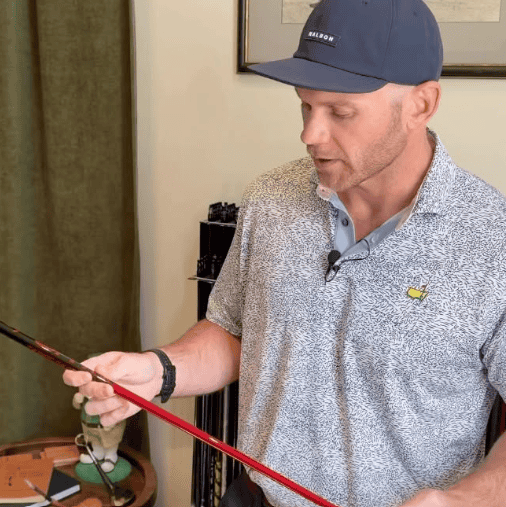
Other than what’s been covered here, it’s beneficial to check your golf clubs and shafts after each trip to the driving range or day on the course. Inspect club faces for scratches, rust, and other signs of damage, and check each shaft for scratches, too.
Graphite golf shafts can be flexed ever so slightly, which will show any weak areas, or areas where the epoxy has started to break down. If you see any fraying, splintering or delamination (areas where the fibers are separating) the shaft should be replaced as soon as possible.
Otherwise, this post covers the bulk of what constitutes responsible golf club and shaft ownership and maintenance. Hopefully you found this guide helpful; bookmark our blog for more tips like these and get in touch with us if you have more specific questions about your equipment that haven’t been answered here.
One of the things with which golfers of all skill levels face a great challenge is keeping their putts consistently straight. All too often, you can square up with the ball, visualize the putting line, keep your putting arc straight, and still, the ball seems to veer off one way or the other.
To that end, a “push” occurs in putting when the putt trends off to the right of the target line. A “pull” occurs when the opposite happens; the putt skews to the left of the intended target. both can be frustrating.
Part of the problem with diagnosing these putting errors is that it’s not always one thing that causes them across the board. Golfers can struggle with different aspects of consistency in swing mechanics that can cause either pushes or pulls.
However, let’s look at some fundamentals. A push occurs if, for whatever reason, the putter face is open when it contacts the ball. A pull will occur if the putter face is closed when it contacts the ball.
What’s even more frustrating is that, even for very close putts, say, within ten feet, if the putter face is off of square by even as little as one degree, it can cause a push or pull that will result in a miss. The issue is figuring out the reason why.
That said, one big cause of these putting errors occurs when golfers engage their entire body to execute the putting stroke. While you do want to engage the large muscles in your back and shoulders, you want your hips and lower body, as well as your arms, hands and wrists, to remain mostly still. Some movement is acceptable, but you want most of the motion and power for the putt to come from the large, stable muscles in your back and shoulders.
If you sway your hips or flex your knees as you putt, the entire mechanical sequence of the putt will break down. Swinging your shoulders or lifting your head to look at the putt (or even moving it unduly at all) can have the same disastrous effect. Even a little bit of movement that isn’t tied to the putting stroke can cause the putter face to open or close, resulting in a push or pull, and a subsequent miss.
The large muscles in your back and shoulders are also more stable than the smaller, “twitchier” muscles in your arms, specifically in your forearms, that drive control through your wrists and hands.
One potential issue here is if the golfer focuses too much on his or her hands, trying to “hit the ball with their hands”. If the lead wrist cups, it can cause the putter face to open which will manifest as a push. Conversely, if the lead wrist flexes, the face will close which will cause a pull.
A little bit of awareness here, or using a monitor or working with a coach, can potentially help you identify if you are driving the putt predominantly with your back and shoulders, or if you are breaking good form and using your arms and hands to putt.
Another potential issue that golfers face is inconsistent grip pressure, especially applying too much right as the putter head contacts the ball. You should hold the putter loosely; too much pressure can cause the face to open or close.
Specifically, some golfers start the putt stroke with an appropriate amount of grip pressure, and then squeeze the grip ever so slightly right before the putter makes contact. This last second change in pressure can easily rotate the putter face into an open or closed configuration. And, again, even the slightest and most inconspicuous twist can severely affect accuracy.
Setting up with the ball too far forward or backward with respect to your stance can also present issues. If this is the case, the putter will contact it in a place where it is still open or closed, instead of being square.
Knowing this, here are a few things you can do to help ensure proper and consistent putting mechanics:
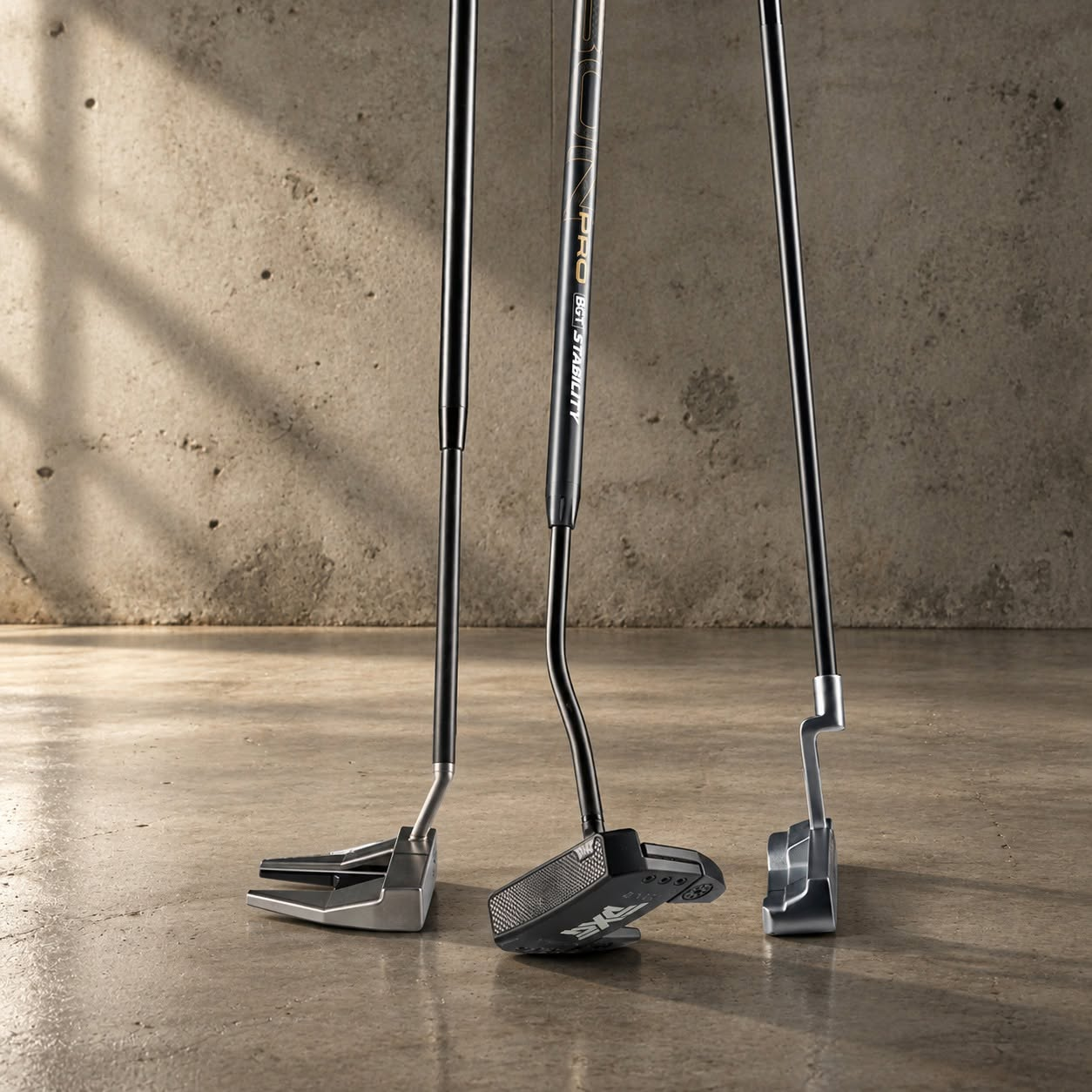
While you shouldn’t scrutinize your equipment as a golfer to address issues with your swing mechanics, it is entirely conceivable that you are playing with equipment that works against your stroke.
For instance, if you know for certain that you have a straight front-to-back putting stroke, a face-balanced putter may be a better option for you than a blade putter. Blade putters tend to exhibit toe hang which fits a stroke with a natural arc because the putter will want to close at the moment of impact.
It's possible that playing with a blade putter if you have a straight front to back stroke may work against you because you will want to fight the slight rotation of the club head through the stroke. Conversely, if you know your putting stroke exhibits more of an arc, it can make more sense to play with a blade putter because the head will want to close at impact; playing with a face-balanced putter may cause mechanical resistance, forcing you to “fight” the club head to keep it square when your stroke wants to exhibit its natural arc.
This, is, however, not always the case, and blade putters can exhibit a wide variety of balance characteristics that should be taken into account when fitting, along with club rotation, delivery, setup, shaft axis and torque characteristics, and more.
Of course, these are just high-level observations. The first thing you need to do before you adopt new equipment is develop proper and consistent form and putting technique. Then you can drill down to determine if an upgrade to a new putter is the right move for you.
If you have any questions on that matter, get in touch with us and our experts will help answer any questions you might have beforehand.
Most traditional putters are thin blade putters with a bit of toe hang that favor golfers that have a slight arc to their stroke, but as more and more professionals choose mallet putters, with their wider, broader heads, greater mass and stability, face-balanced design, and profusion of visual aids, intrigue around them grows.
This being the case, here are a few important things you should understand about mallet putters, how they are designed, and what they are intended to deliver.
Most traditional blade putters have toe hang, which means that if you balance the putter by the shaft, the toe will hang downwards, towards the ground. The reason for this weighting configuration is that many golfers have a slight arc to their stroke; this arc, which incurs rotation of the club face, necessitates a design that closes naturally at the point of impact.
This is precisely what blade putters with toe hang are designed to do. The weighting, slightly concentrated in the toe, encourages the putter face to close right at the point of impact, delivering a more consistent, accurate putt, specifically for players with a more natural arc to their stroke.
Mallet putters are commonly face balanced, which means that they exhibit neither toe nor heel hang. In other words, if you balanced the putter by the shaft, the face would point directly upwards towards the sky.
A face balanced putter will neither open nor close through a putt stroke, but is designed to stay square through a straight stroke. As a result, face balanced putters tend to deliver optimal results for golfers who have straight front to back strokes.
Now, we need to drill down into the performance of a face-balanced mallet putter here because there is a specific reason that they are often not the go-to choice for golfers with an arcing putt stroke, despite the fact that they are growing in popularity.
If you know that your putt stroke has an arc to it, a face balanced putter may potentially work against you. The toe hang of a traditional blade putter will accommodate your stroke and the extra mass in the toe will encourage the putter to close at contact with the ball, delivering more consistent and accurate putts.
A face balanced putter will potentially work against you, especially the more arc there is to your putting stroke. It may contact the ball with an open face, which can cause the putt to push off to the right, resulting in less accurate putts and inconsistent performance on the green.
Golfers may then begin altering their natural stroke to compensate for the putter, often creating even more inconsistency.
As a result, while there is a lot of hype surrounding face-balanced mallet putters right now, it is important to remember that despite their many virtues they are not always the best option for all golfers.
Another great thing about mallet putters is that they are often touted as offering greater stability and forgiveness, especially on mishits, and by and large this is true.
Because a face-balanced putter works naturally to keep the club face square with the original target line, it resists twisting, which generally will make it more accommodating of mishits. While no putter can correct a poor stroke, mallet putters tend to offer more forgiveness on off-center contact.
Face-balanced putters with their higher mass also tend to offer higher MOI, or “moment of inertia”, which refers to the club head’s ability to resist twisting. Together, a high MOI paired with a face-balanced design results in exceptional stability and can encourage putts to travel straight, even when contact is made slightly closer to the toe or heel than to the center of the putter face.
Your natural putting stroke should still be considered, but face-balanced mallet putters generally offer more forgiveness on off-center contact.
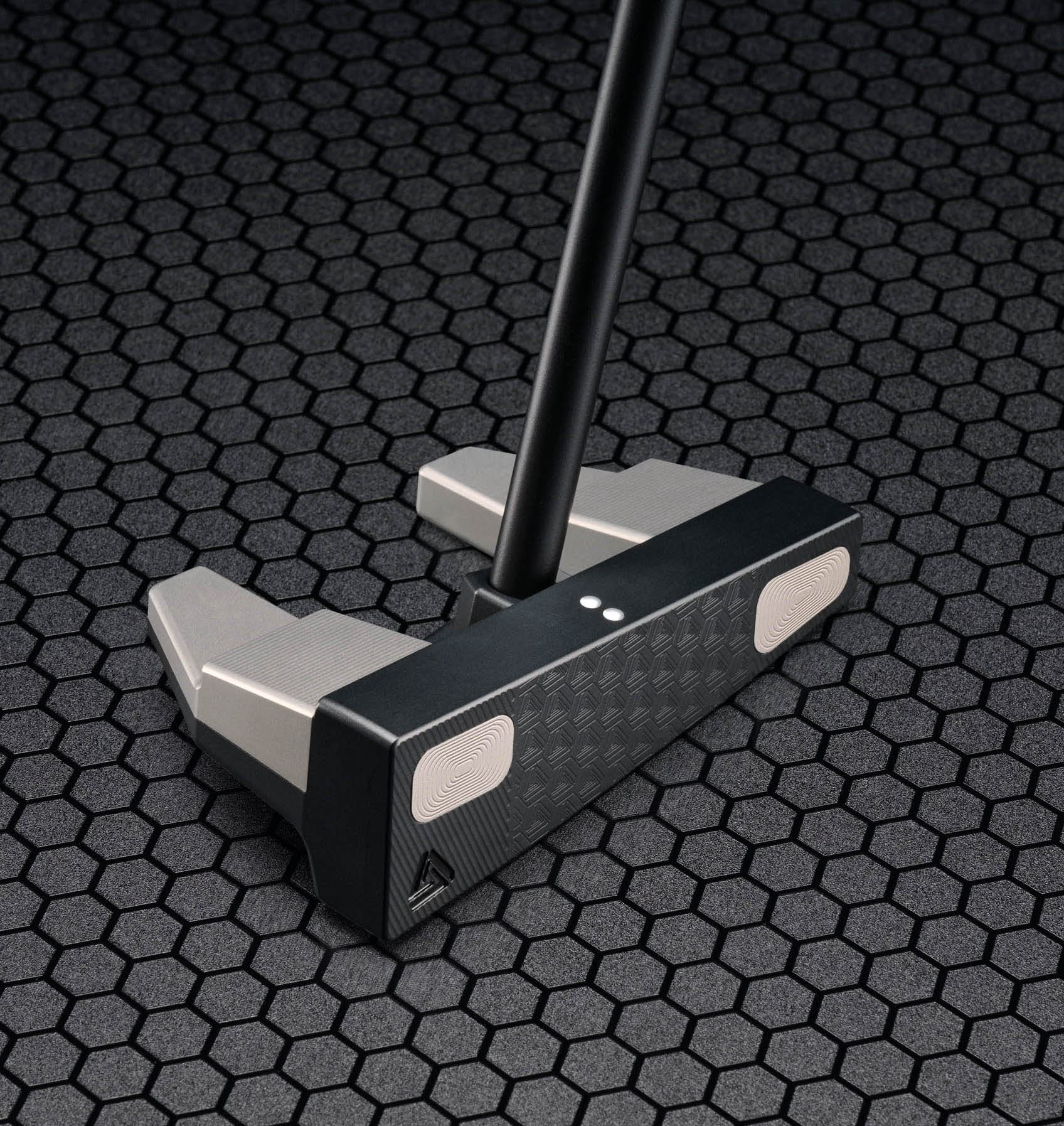
One other thing that mallet putters tend to offer is a greater number of visual alignment aids, which consist of a series of lines, dots, high-contrasting color shapes, or other visual cues, marked into the top surface of the putter, which help the golfer visualize the alignment of the putter head and face, and the intended path of the ball.
Now, there are some golfers that find these alignment aids distracting and cluttering, but there are many other golfers that insist that they improve their ability to visualize the path of the putt. You may very well find that you prefer them, but to find out, you’ll have to practice at some point or other with a putter that offers them.
Whether or not a traditional blade putter with slight toe hang or a face-balanced mallet putter that’s rich in visual alignment aids is for you is a matter of personal preference. We just hope you found this short exposition of mallet putters to be helpful.
If you have any questions about the features of the putters or putter shafts we offer, get in touch with us and we will be more than happy to help you get to the bottom of it.
Blade putters offer a clean, compact, traditional aesthetic and are preferred by some golfers, especially those with a slight arc to their stroke, since blade putters tend to have a bit of toe hang that helps the putter face to close at the moment of impact.
But, at the same time, blade putters may not be for everyone, so we rounded up some of the more common questions from the web to answer them here. See if your question is answered here and if not get in touch with us.
A blade putter is a putter with a compact, thin head and a slim, narrow profile. Most traditional putters have a blade profile.
Blade putters tend to be better for players that have an arcing stroke, one that opens and closes slightly through the stroke. The toe hang of most blade putters naturally allows the putter to open with the stroke and close at the critical moment of impact. Some players also argue that blade putters offer better touch and more sensitive feedback as well.
Anyone who appreciates the classic aesthetic of traditional putters can appreciate a blade putter, but really, they usually perform best in the hands of golfers that have a slight arc to their stroke. Players with a straighter, more front-to-back stroke gravitate towards mallet putters.
There are still pros that play with blade putters (such as Harry Hall, Tiger Woods, and Hideki Matsuyama), but many are increasingly preferring the stability and performance of modern mallet putters.
While blade putters can offer excellent feedback and tend to close naturally for players who have an arcing swing, many mallet putters are more forgiving and offer excellent consistency. Mallet putters can also produce tight dispersion on the green.
The main downside of blade putters is that they can be particularly unforgiving of mishits that are off center. Not only are off-center mishits more likely to deviate from the intended course, but the energy transfer is far less efficient on off-center hits, causing errant putts to lose speed much more quickly.
Also, if your stroke lacks a natural arc, playing with a blade putter will cause you to fight the club’s natural rotation. This itself can cause inconsistencies that translate into the ball losing momentum early, or to a lower degree of accuracy.
Potentially, but that really depends on your level of skill, whether or not you have a slight arc to your stroke, and how heavily you rely on alignment aids.
As has been stated, those with more straight strokes tend to prefer mallet putters, and mallet putters are more forgiving regardless.
But, it is also the case that many mallet putters have a variety of alignment aids. Many blade putters have only one alignment aid, if they have any at all. Some golfers, especially those who are highly reliant on their visual senses, prefer mallet putters for this reason as well.
Not to paint with broad strokes here, but high handicappers may generally be better served by mallet putters because they are more forgiving of mishits and can offer greater stability as well.
No, blade putters are generally not more forgiving than mallet putters. While blade putters can serve some golfers admirably, if your main concern is forgiveness, a mallet putter is likely a better option for you.
That’s hard to answer because a blade putter can be good for a beginner that has an arcing stroke. However, as a general rule, the forgiveness of a mallet putter is more amenable to most beginners.
A face-balanced mallet putter is the best way to keep your face square with the ball, especially if you have a straight front-to-back stroke. A zero-torque putter shaft is also a good option in this case.
However, if you have an arcing stroke, a blade putter may naturally square at the point of impact.
While it is true that blade putters tend to be lighter than mallet putters, it is not the case that a heavier putter or a lighter putter is necessarily better than the other. They simply offer different performance attributes.
Heavier putters tend to be more stable, especially for shorter putts. On the flipside, lighter putters tend to provide better touch, feedback and control. Really, which is better for you depends on your skills, abilities, and preferences.
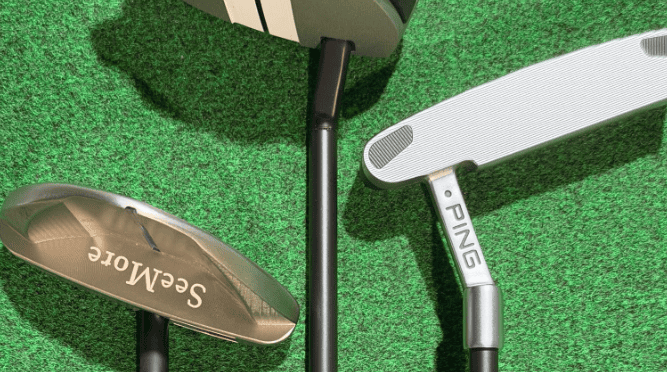
Don’t See Your Question Here? Get in Touch with the BGT Pros
Not sure if a blade putter or a mallet putter is best for you? Looking for more information on zero-torque putter shafts before you make any decisions about upgrading your equipment?
Get in touch with our professionals, let us know what you are looking for and we will make personalized recommendations to help ensure you are playing with clubs that are as well tailored to your abilities as possible.
As a golfer, you may come across a very unique situation; you read the putt, execute the putt, and everything looks and feels right. The ball even starts off straight on the path you visualized.
But then, it slowly starts to push off to the right.
It’s not specifically that you did anything wrong; it’s more that your putter may be balanced in such a way that you needed to execute a motion you wouldn’t naturally, and therefore didn’t, make.
It could just be that your putter didn’t square perfectly right at impact, pushing the ball off slightly to the right.
It also brings up the matter of putter balance. Two of the most common types of putter balanced are putters that exhibit toe hang and face balanced putters.
Neither is a universal solution to the many issues of putting accuracy, but understanding the natural arc of your stroke can help you choose a putter that’s better suited for you.
What Is Toe Hang?
A putter is said to have “toe hang” if, when it is balanced on a finger, the toe points downward. In other words, a putter with toe hang has more mass near the toe and the center of gravity is shifted towards the toe, rather than towards the heel.
Because of the distribution of mass, a putter that exhibits toe hang will open slightly on the backstroke and close as the face is brought forward. If your stroke has a natural arc, this effect will be magnified.
For this reason, putters with toe hang are often promoted for players that have more of a natural arc to their strokes, because the putter face will close naturally during the stroke without any additional effort from the golfer.
A closely related term here is “toe flow” which refers to the feeling of the toe releasing as the head of the putter rotates. Some golfers love the feeling and others fight it, because it feels like the putter face was too open at impact.
Either way, a putter with toe hang can potentially benefit golfers with more of an arc to their stroke because it helps naturally close the face of the putter.
But, for players with a more straight-to-back stroke, with less of an arc, sometimes a face balanced putter is a better choice.
Toe Hang vs. Face Balanced?
In contrast to putters with toe hang, a face balanced putter is a putter with a face that points upward when the putter is balanced on a finger. The mass distribution in the club head is such that toe hang is eliminated in a face balanced putter.
Because of this, face balanced putters are sometimes promoted for players with more straight-to-back putt strokes, with little to no arc, because the balance of the putter head will keep the face square through the stroke and at the moment of impact, with no additional action required from the golfer.
A face balanced putter also naturally resists twisting, which can make for a suitable pairing with a zero-torque putter shaft, since together, the club and shaft pairing helps to keep the face square, increasing consistency and accuracy.
Missing Putts Right: When Does a Face Balanced Putter Make Sense?
If you play with a putter that has a lot of toe hang, and the head rotates during the stroke more than the stroke can support, the face may be open at impact, causing the ball to push off to the right.
If your stroke has less natural arc, you play with a zero-torque shaft, and don’t hold the face off one way or the other, the precision of a face balanced putter, especially with a straight front-to-back stroke (or one that is nearly so) may be able to help prevent those putts that roll off right.
Of course, there is more than one factor here, but being aware of some of the conditions that can cause these errors can still be helpful.

Still Have Questions?
At the end of the day, it’s important to recognize that there is no perfect putting stroke, nor is it the case that one is better than the other. Arcing strokes and straight strokes can both deliver accurate putts. The goal isn’t to develop the ideal stroke; it’s to understand what your putter stroke looks like so you can match the putter and putter shaft to it in order to deliver the best results.
That being the case, if you’re still struggling with putting accuracy on the green and would like the assistance of an expert who may be able to help you identify what your stroke looks like, then suggest the ideal putter and shaft combo to better meet your natural abilities, get in touch with us directly and we will be more than happy to assist.
Have you been wondering if you’re playing with the right type of putter? You’re not the only one out there wondering the same thing, and considering how important putting is to the sport, it’s a reasonable question to ask. So, here it is: is a mallet or a blade putter better for you?
That really depends. Both can be effective styles, but perform differently due to the shape of the putter head as well as balance and weighting. Let’s take a closer look.
Who Should Play with a Mallet Putter?
First let’s look at mallet putters. These are larger putters, with a head shape that is often semi-circular or square, though some mallet putters have “wings” that extend behind the club face.
This different shape changes the way the weight is distributed around the putter head, with more of it distributed around the rear of the club or around the perimeter.
This weighting configuration can change the MOI, or moment of inertia, when the club strikes the ball. It has the potential to make a mallet putter slightly more forgiving when you don’t make perfect contact.
Many mallet putters have a number of visual alignment cues, such as high contrast shapes, lines, or alignment dots, that help golfers visualize the alignment of the putter head and the path of the stroke, to improve their accuracy and consistency.
These visual cues, paired with the fact that mallet putters often deliver a higher MOI which can make them slightly more forgiving in some situations, make them appealing to many newer golfers.
With that said, even skilled golfers sometimes prefer the forgiveness of mallet putters because it can offer the potential to tighten shot dispersion and result in more accurate and consistent putts. Mallet putters, because of their consistency and forgiveness, also excel for making longer putts where that forgiveness comes into focus.
Also, golfers that have a straight-through stroke or only a slight arc may also prefer a mallet putter because the face generally stays square, evening out inconsistencies.
On top of that, some mallet putters feature a modular or customizable design, with inserts or weights that can be added, removed, or even positioned around the clubhead to personalize the putter to a specific golfer’s putting bias.
Another thing to note about mallet putters is that, in terms of auditory and sensory feedback, they tend to be a little softer and less “crisp” than blade putters, especially if they are weighted with inserts that sometimes have a tendency to absorb vibration and feedback.
Who Should Try a Blade Putter?
Now let’s take a closer look at blade putters. Blade putters are a more traditional putter profile, with a compact head, like a blade, hence the name. Most of the mass in a blade putter is situated directly behind the face of the club.
They are usually heel-to-toe weighted and have “toe hang” which means that the toe of the putter points slightly downward if you balance the shaft on a finger. In other words, the toe end of the blade putter’s head is usually ever so slightly heavier than the heel.
Importantly, toe hang encourages the putter to open slightly on the back stroke and close a little on the forward stroke, which helps square the putter when the golfer has a slight arc to his or her stroke.
Generally, blade putters offer a simpler design and cleaner aesthetic than mallet putters, and they’re usually not configurable with weights and inserts, making them less customizable.
Blade putters tend to be slightly less forgiving than mallet putters, but they offer precise, consistent feel and often better feedback than mallet putters, too. For these reasons, many golfers prefer them, especially those who have more of a pronounced arc to their stroke.
Also, while blade putters tend to be less forgiving, especially with less than perfect contact, with solid, center face contact they provide not only excellent feedback, but very consistent results. So while it can potentially take more practice to become proficient with a blade putter, the results can be worth it if you put in the time and practice.
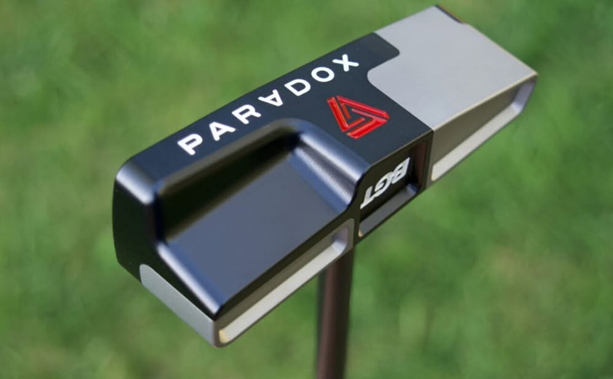
Summarizing Blade vs. Mallet Putters
To recapitulate:
So, Which Is Better for You?
As is true in so many things in life, it really depends. Neither blade putters nor mallet putters are inherently or objectively better than the other. It’s all about what you prefer.
If you are a golfer with more of an arc to your stroke, and you prefer feedback over forgiveness, or if you prefer traditional aesthetics and equipment, a blade putter might be a better option for you.
On the flipside, if you prioritize forgiveness over feedback and you have a straighter stroke with less of an arc, then a mallet putter might suit you better than a blade putter.
Questions? Contact Us
Not sure whether a mallet putter or a blade putter is the better choice for you, but open to trying something new? Get in touch with us and let us know what your challenges on the green are, and we will make specific recommendations for putter and shaft combos that may be able to help you.


