
One of the things with which golfers of all skill levels face a great challenge is keeping their putts consistently straight. All too often, you can square up with the ball, visualize the putting line, keep your putting arc straight, and still, the ball seems to veer off one way or the other.
To that end, a “push” occurs in putting when the putt trends off to the right of the target line. A “pull” occurs when the opposite happens; the putt skews to the left of the intended target. both can be frustrating.
Part of the problem with diagnosing these putting errors is that it’s not always one thing that causes them across the board. Golfers can struggle with different aspects of consistency in swing mechanics that can cause either pushes or pulls.
However, let’s look at some fundamentals. A push occurs if, for whatever reason, the putter face is open when it contacts the ball. A pull will occur if the putter face is closed when it contacts the ball.
What’s even more frustrating is that, even for very close putts, say, within ten feet, if the putter face is off of square by even as little as one degree, it can cause a push or pull that will result in a miss. The issue is figuring out the reason why.
That said, one big cause of these putting errors occurs when golfers engage their entire body to execute the putting stroke. While you do want to engage the large muscles in your back and shoulders, you want your hips and lower body, as well as your arms, hands and wrists, to remain mostly still. Some movement is acceptable, but you want most of the motion and power for the putt to come from the large, stable muscles in your back and shoulders.
If you sway your hips or flex your knees as you putt, the entire mechanical sequence of the putt will break down. Swinging your shoulders or lifting your head to look at the putt (or even moving it unduly at all) can have the same disastrous effect. Even a little bit of movement that isn’t tied to the putting stroke can cause the putter face to open or close, resulting in a push or pull, and a subsequent miss.
The large muscles in your back and shoulders are also more stable than the smaller, “twitchier” muscles in your arms, specifically in your forearms, that drive control through your wrists and hands.
One potential issue here is if the golfer focuses too much on his or her hands, trying to “hit the ball with their hands”. If the lead wrist cups, it can cause the putter face to open which will manifest as a push. Conversely, if the lead wrist flexes, the face will close which will cause a pull.
A little bit of awareness here, or using a monitor or working with a coach, can potentially help you identify if you are driving the putt predominantly with your back and shoulders, or if you are breaking good form and using your arms and hands to putt.
Another potential issue that golfers face is inconsistent grip pressure, especially applying too much right as the putter head contacts the ball. You should hold the putter loosely; too much pressure can cause the face to open or close.
Specifically, some golfers start the putt stroke with an appropriate amount of grip pressure, and then squeeze the grip ever so slightly right before the putter makes contact. This last second change in pressure can easily rotate the putter face into an open or closed configuration. And, again, even the slightest and most inconspicuous twist can severely affect accuracy.
Setting up with the ball too far forward or backward with respect to your stance can also present issues. If this is the case, the putter will contact it in a place where it is still open or closed, instead of being square.
Knowing this, here are a few things you can do to help ensure proper and consistent putting mechanics:
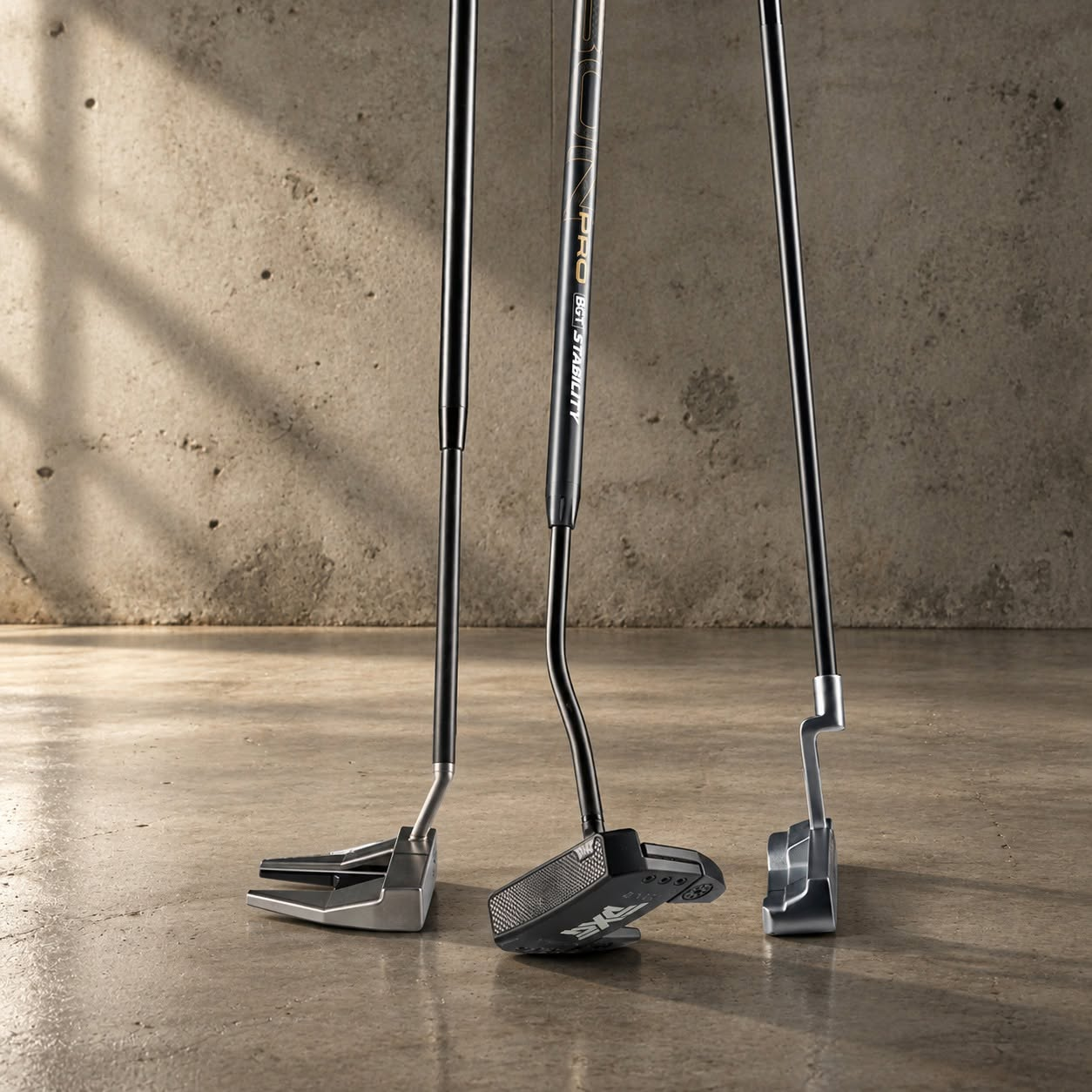
While you shouldn’t scrutinize your equipment as a golfer to address issues with your swing mechanics, it is entirely conceivable that you are playing with equipment that works against your stroke.
For instance, if you know for certain that you have a straight front-to-back putting stroke, a face-balanced putter may be a better option for you than a blade putter. Blade putters tend to exhibit toe hang which fits a stroke with a natural arc because the putter will want to close at the moment of impact.
It's possible that playing with a blade putter if you have a straight front to back stroke may work against you because you will want to fight the slight rotation of the club head through the stroke. Conversely, if you know your putting stroke exhibits more of an arc, it can make more sense to play with a blade putter because the head will want to close at impact; playing with a face-balanced putter may cause mechanical resistance, forcing you to “fight” the club head to keep it square when your stroke wants to exhibit its natural arc.
This, is, however, not always the case, and blade putters can exhibit a wide variety of balance characteristics that should be taken into account when fitting, along with club rotation, delivery, setup, shaft axis and torque characteristics, and more.
Of course, these are just high-level observations. The first thing you need to do before you adopt new equipment is develop proper and consistent form and putting technique. Then you can drill down to determine if an upgrade to a new putter is the right move for you.
If you have any questions on that matter, get in touch with us and our experts will help answer any questions you might have beforehand.


