
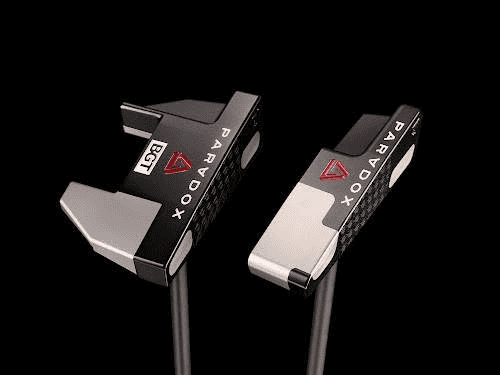
As a golfer, you may come across a very unique situation; you read the putt, execute the putt, and everything looks and feels right. The ball even starts off straight on the path you visualized.
But then, it slowly starts to push off to the right.
It’s not specifically that you did anything wrong; it’s more that your putter may be balanced in such a way that you needed to execute a motion you wouldn’t naturally, and therefore didn’t, make.
It could just be that your putter didn’t square perfectly right at impact, pushing the ball off slightly to the right.
It also brings up the matter of putter balance. Two of the most common types of putter balanced are putters that exhibit toe hang and face balanced putters.
Neither is a universal solution to the many issues of putting accuracy, but understanding the natural arc of your stroke can help you choose a putter that’s better suited for you.
What Is Toe Hang?
A putter is said to have “toe hang” if, when it is balanced on a finger, the toe points downward. In other words, a putter with toe hang has more mass near the toe and the center of gravity is shifted towards the toe, rather than towards the heel.
Because of the distribution of mass, a putter that exhibits toe hang will open slightly on the backstroke and close as the face is brought forward. If your stroke has a natural arc, this effect will be magnified.
For this reason, putters with toe hang are often promoted for players that have more of a natural arc to their strokes, because the putter face will close naturally during the stroke without any additional effort from the golfer.
A closely related term here is “toe flow” which refers to the feeling of the toe releasing as the head of the putter rotates. Some golfers love the feeling and others fight it, because it feels like the putter face was too open at impact.
Either way, a putter with toe hang can potentially benefit golfers with more of an arc to their stroke because it helps naturally close the face of the putter.
But, for players with a more straight-to-back stroke, with less of an arc, sometimes a face balanced putter is a better choice.
Toe Hang vs. Face Balanced?
In contrast to putters with toe hang, a face balanced putter is a putter with a face that points upward when the putter is balanced on a finger. The mass distribution in the club head is such that toe hang is eliminated in a face balanced putter.
Because of this, face balanced putters are sometimes promoted for players with more straight-to-back putt strokes, with little to no arc, because the balance of the putter head will keep the face square through the stroke and at the moment of impact, with no additional action required from the golfer.
A face balanced putter also naturally resists twisting, which can make for a suitable pairing with a zero-torque putter shaft, since together, the club and shaft pairing helps to keep the face square, increasing consistency and accuracy.
Missing Putts Right: When Does a Face Balanced Putter Make Sense?
If you play with a putter that has a lot of toe hang, and the head rotates during the stroke more than the stroke can support, the face may be open at impact, causing the ball to push off to the right.
If your stroke has less natural arc, you play with a zero-torque shaft, and don’t hold the face off one way or the other, the precision of a face balanced putter, especially with a straight front-to-back stroke (or one that is nearly so) may be able to help prevent those putts that roll off right.
Of course, there is more than one factor here, but being aware of some of the conditions that can cause these errors can still be helpful.
Still Have Questions?
At the end of the day, it’s important to recognize that there is no perfect putting stroke, nor is it the case that one is better than the other. Arcing strokes and straight strokes can both deliver accurate putts. The goal isn’t to develop the ideal stroke; it’s to understand what your putter stroke looks like so you can match the putter and putter shaft to it in order to deliver the best results.
That being the case, if you’re still struggling with putting accuracy on the green and would like the assistance of an expert who may be able to help you identify what your stroke looks like, then suggest the ideal putter and shaft combo to better meet your natural abilities, get in touch with us directly and we will be more than happy to assist.


