

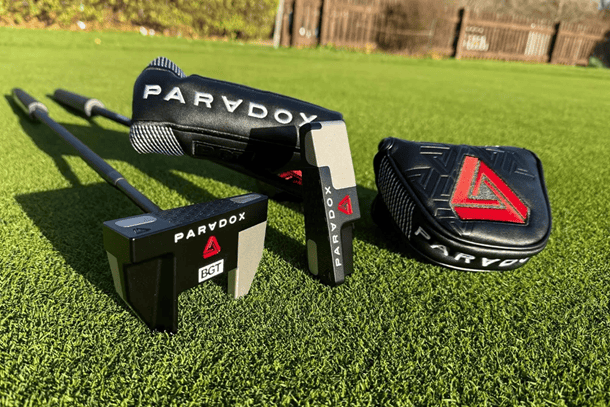
Have you been wondering if you’re playing with the right type of putter? You’re not the only one out there wondering the same thing, and considering how important putting is to the sport, it’s a reasonable question to ask. So, here it is: is a mallet or a blade putter better for you?
That really depends. Both can be effective styles, but perform differently due to the shape of the putter head as well as balance and weighting. Let’s take a closer look.
Who Should Play with a Mallet Putter?
First let’s look at mallet putters. These are larger putters, with a head shape that is often semi-circular or square, though some mallet putters have “wings” that extend behind the club face.
This different shape changes the way the weight is distributed around the putter head, with more of it distributed around the rear of the club or around the perimeter.
This weighting configuration can change the MOI, or moment of inertia, when the club strikes the ball. It has the potential to make a mallet putter slightly more forgiving when you don’t make perfect contact.
Many mallet putters have a number of visual alignment cues, such as high contrast shapes, lines, or alignment dots, that help golfers visualize the alignment of the putter head and the path of the stroke, to improve their accuracy and consistency.
These visual cues, paired with the fact that mallet putters often deliver a higher MOI which can make them slightly more forgiving in some situations, make them appealing to many newer golfers.
With that said, even skilled golfers sometimes prefer the forgiveness of mallet putters because it can offer the potential to tighten shot dispersion and result in more accurate and consistent putts. Mallet putters, because of their consistency and forgiveness, also excel for making longer putts where that forgiveness comes into focus.
Also, golfers that have a straight-through stroke or only a slight arc may also prefer a mallet putter because the face generally stays square, evening out inconsistencies.
On top of that, some mallet putters feature a modular or customizable design, with inserts or weights that can be added, removed, or even positioned around the clubhead to personalize the putter to a specific golfer’s putting bias.
Another thing to note about mallet putters is that, in terms of auditory and sensory feedback, they tend to be a little softer and less “crisp” than blade putters, especially if they are weighted with inserts that sometimes have a tendency to absorb vibration and feedback.
Who Should Try a Blade Putter?
Now let’s take a closer look at blade putters. Blade putters are a more traditional putter profile, with a compact head, like a blade, hence the name. Most of the mass in a blade putter is situated directly behind the face of the club.
They are usually heel-to-toe weighted and have “toe hang” which means that the toe of the putter points slightly downward if you balance the shaft on a finger. In other words, the toe end of the blade putter’s head is usually ever so slightly heavier than the heel.
Importantly, toe hang encourages the putter to open slightly on the back stroke and close a little on the forward stroke, which helps square the putter when the golfer has a slight arc to his or her stroke.
Generally, blade putters offer a simpler design and cleaner aesthetic than mallet putters, and they’re usually not configurable with weights and inserts, making them less customizable.
Blade putters tend to be slightly less forgiving than mallet putters, but they offer precise, consistent feel and often better feedback than mallet putters, too. For these reasons, many golfers prefer them, especially those who have more of a pronounced arc to their stroke.
Also, while blade putters tend to be less forgiving, especially with less than perfect contact, with solid, center face contact they provide not only excellent feedback, but very consistent results. So while it can potentially take more practice to become proficient with a blade putter, the results can be worth it if you put in the time and practice.
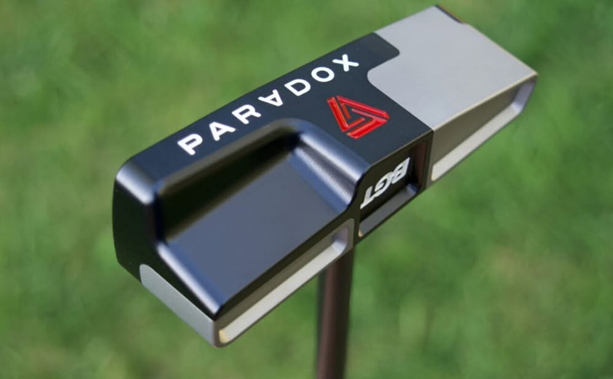
Summarizing Blade vs. Mallet Putters
To recapitulate:
So, Which Is Better for You?
As is true in so many things in life, it really depends. Neither blade putters nor mallet putters are inherently or objectively better than the other. It’s all about what you prefer.
If you are a golfer with more of an arc to your stroke, and you prefer feedback over forgiveness, or if you prefer traditional aesthetics and equipment, a blade putter might be a better option for you.
On the flipside, if you prioritize forgiveness over feedback and you have a straighter stroke with less of an arc, then a mallet putter might suit you better than a blade putter.
Questions? Contact Us
Not sure whether a mallet putter or a blade putter is the better choice for you, but open to trying something new? Get in touch with us and let us know what your challenges on the green are, and we will make specific recommendations for putter and shaft combos that may be able to help you.


